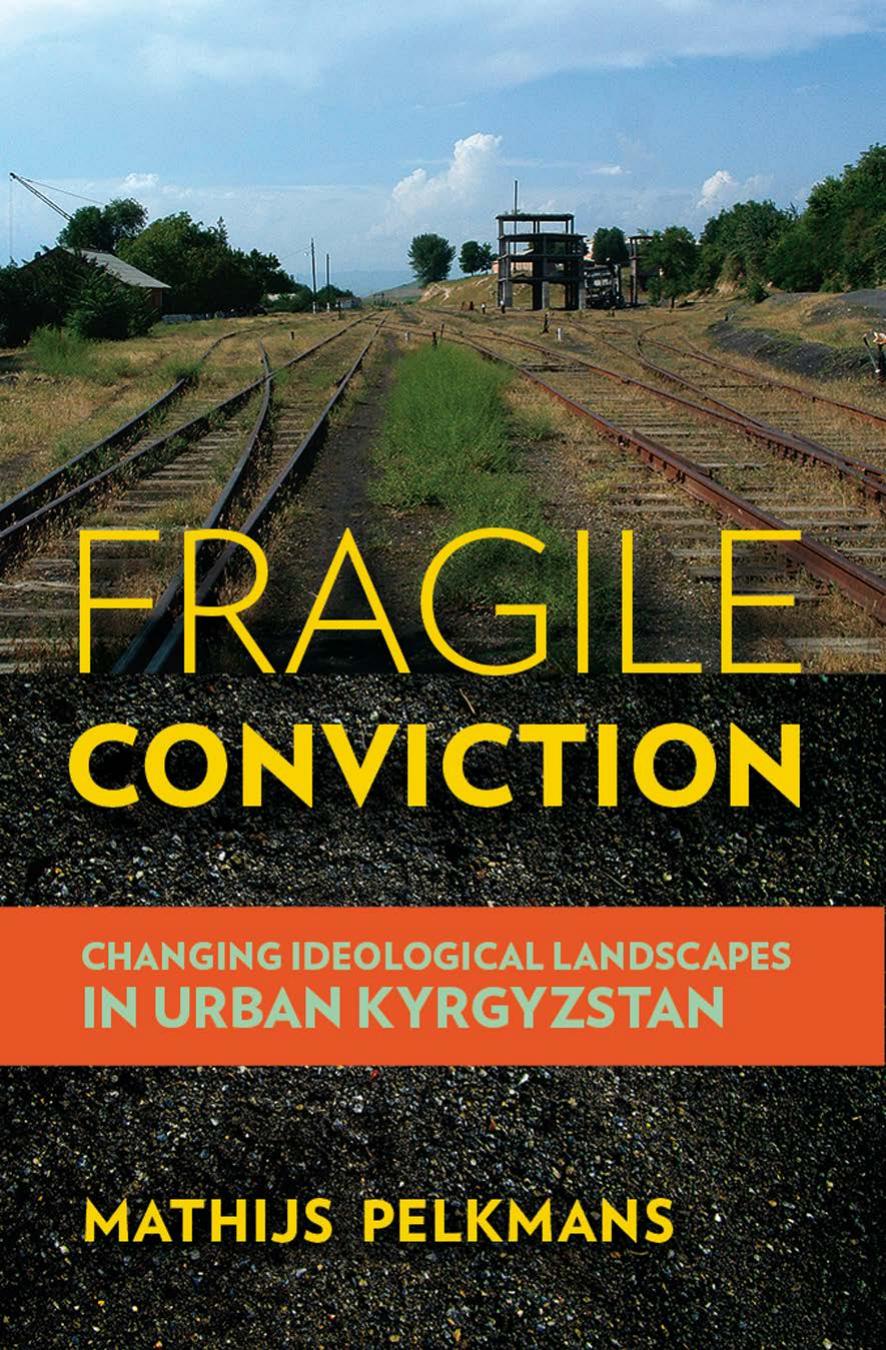
Fragile Conviction by Mathijs Pelkmans
Author:Mathijs Pelkmans [Pelkmans, Mathijs]
Language: eng
Format: epub, pdf
Tags: Social Science, Anthropology, Cultural & Social, History, Asia, Central Asia, Religion, Religion; Politics & State
ISBN: 9781501708374
Google: DumTDgAAQBAJ
Publisher: Cornell University Press
Published: 2017-03-14T22:26:21+00:00
Enchanting Stories
A Tablighi acquaintance who accompanied me on several interviews told me with a laugh: âAs you see, it is not easy to interview dawatchis; they talk too much.â22 Most of my questions remained indeed unanswered, but listening to their stories was all the more revealing. So after I had joined this acquaintance on several dawats, he told others: âHis approach to research is a bit unconventional. He rarely asks questions, he just listens to what people have to say.â
Stories are essential for meaningful living. In his book about Serbia in the early 1990s, Mattijs van de Port writes that he was struck by âeveryoneâs complete reliance on a story, a story that can give meaning, direction and purpose to (certain aspects of) lifeâ (1998, 29). He refers to this as ânarrated/narrating realityâ (verhaalde werkelijkheid) a term that suggests the inseparability between the world and experience (1994, 50â56; 1998, 50â52). In other words, stories do more than reflect and refract the world; they also shape lived reality, and do so by engaging the listener as well as the speaker. Rane Willerslev suggests that stories can be âa âmagicalâ tool for âhumanizingâ huntersâ (2007, 165), and according to Susan Harding (1987) it is through talking and telling stories that evangelical Baptists convert others. Stories are an important part of what constitutes experience, and they are tools for convincing others and self of what is true, important, or right.
In the case of the Tablighis stories were important venues by which dawat success was produced. Marc Gaboriau writes that Tablighi literature âis always anxious to proclaim that the preaching tours obtained wonderful resultsâ (2000, 136). Or as amir Nur Islam put it to our fellowship, during dawat one should talk only about religion (deen) and focus on the positive, rather than allow Satan-inspired (shaitan) negativity. Metcalf stresses the centrality of stories for the Tablighi movement, which âengage the listener, ⦠not only intellectually but emotionallyâ (1993, 593) and aim to achieve âexperiential, not intellectual understandingâ (1996, 110).
This section tries to understand how, through stories, such emotional connections and experiential understandings are produced. According to Geertz (1973, 100) âThere are at least three points where chaosâa tumult of events which lack not just interpretations but interpretabilityâthreatens to break in upon man.â His three points, or limits, are those pertaining to the mind, the body, and the soul, or in his words: âat the limits of his analytic capacities, at the limits of his powers of endurance, and at the limits of his moral insight.â These limits, which are obviously intertwined, also surfaced in stories told by Tablighis. The âlimits of analytic capacityâ resonated in stories that conveyed awe about the Creation and the occurrence of miracles. The âlimits of power and endurance,â referring specifically to the body, were revealed in stories about addiction and sex. The key question about âmoral insightâ in 2010 concerned the episode of violence between Kyrgyz and Uzbeks that left everyone shocked. The stories refract and shape reality, but ultimately
Download
This site does not store any files on its server. We only index and link to content provided by other sites. Please contact the content providers to delete copyright contents if any and email us, we'll remove relevant links or contents immediately.
Spell It Out by David Crystal(36236)
Life for Me Ain't Been No Crystal Stair by Susan Sheehan(35901)
The Great Music City by Andrea Baker(33609)
Cecilia; Or, Memoirs of an Heiress — Volume 1 by Fanny Burney(32720)
Cecilia; Or, Memoirs of an Heiress — Volume 2 by Fanny Burney(32088)
Cecilia; Or, Memoirs of an Heiress — Volume 3 by Fanny Burney(32065)
Professional Troublemaker by Luvvie Ajayi Jones(29759)
The Secret History by Donna Tartt(19467)
We're Going to Need More Wine by Gabrielle Union(19168)
Twilight of the Idols With the Antichrist and Ecce Homo by Friedrich Nietzsche(18775)
All the Missing Girls by Megan Miranda(16693)
Cat's cradle by Kurt Vonnegut(15555)
For the Love of Europe by Rick Steves(14904)
Pimp by Iceberg Slim(14793)
Bombshells: Glamour Girls of a Lifetime by Sullivan Steve(14217)
Norse Mythology by Gaiman Neil(13564)
Talking to Strangers by Malcolm Gladwell(13537)
Fifty Shades Freed by E L James(13347)
The Social Justice Warrior Handbook by Lisa De Pasquale(12293)
